Ten years of my golf, analyzed
Since 2016 I’ve logged almost every round of golf I’ve played, first in Swing by Swing (now SwingU) and then in 18Birdies, and until this week I’d never looked back at any of it. That’s 194 rounds across Colorado, California and Korea. I also had a summer of range sessions from 2024 sitting in my Toptracer account.
So I exported all of it and spent a long session with Claude Code turning it into a dashboard. It’s live at tools.brianshin.me/golf.
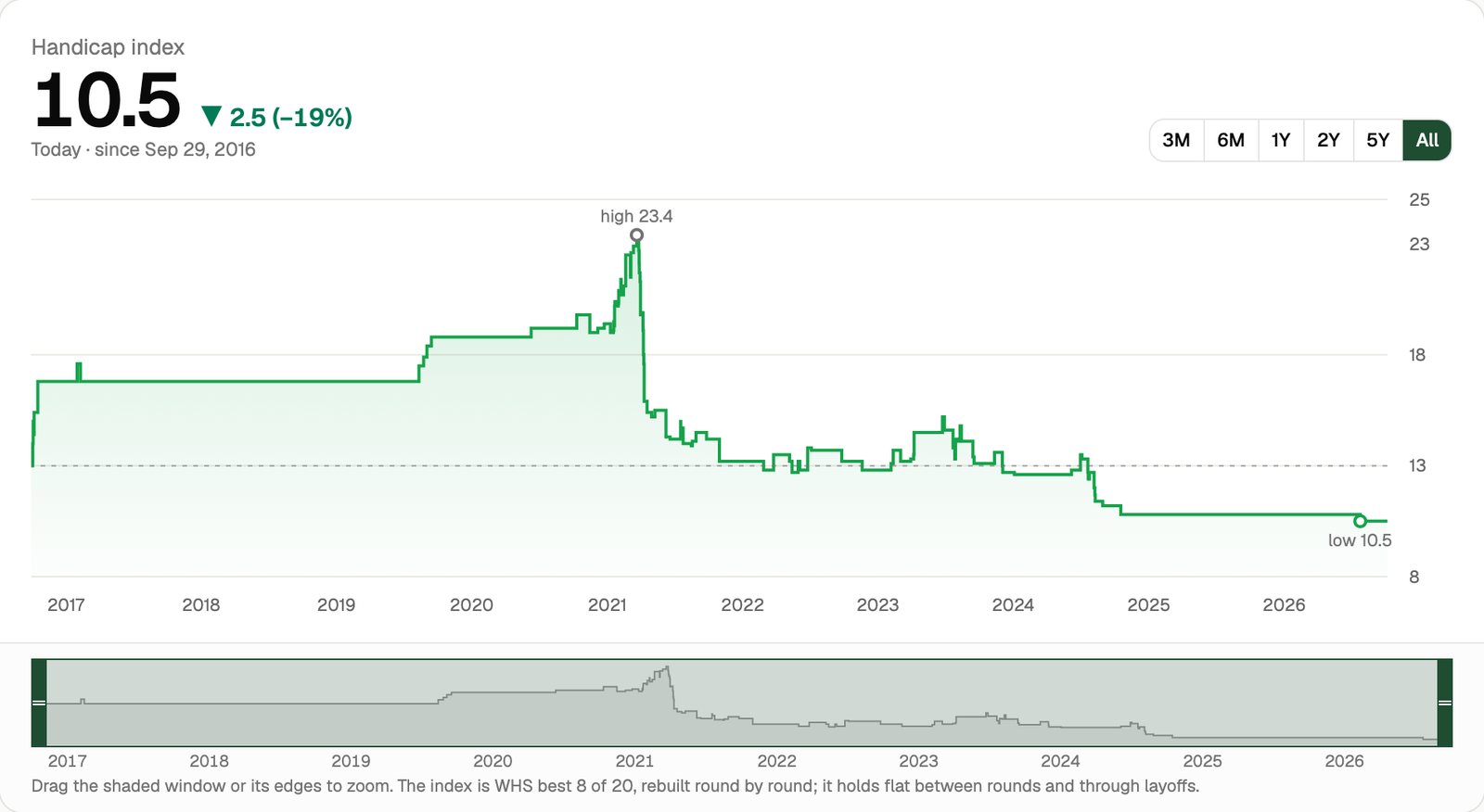
One of my favorite pieces is this chart: my handicap over time, built like a stock chart, so I can scrub through any date or drag the window underneath. My index went from 19.2 (when I first had enough rounds for one, in 2020) to 10.5 today. The spike in early 2021 is me coming back from a long layoff, and the drop after it is the 64 rounds I played that year.
Building it
The first job was getting the data out, and that turned out to be the hard part. I tracked my early rounds in Swing by Swing, which later became SwingU, then switched to 18Birdies at the end of 2020. I honestly don’t remember why. I think SwingU was draining my phone’s battery. None of these apps make it easy to take your history with you. 18Birdies’ came out as an archive of my whole account, and SwingU’s as a raw hole-by-hole file. Toptracer has no export at all; after some digging I found SwingSync, a third-party service that connects to your Toptracer account and pulls every session out as a spreadsheet.
After that, I mostly described what I wanted and judged what came back. Claude did the building.
The data was messier than I expected. 18Birdies doesn’t export the par for each hole, so Claude tracked down the scorecards for the 35 courses I’ve played and matched them to my rounds. It also caught a round I’d logged in both apps.
One disappointment: 18Birdies’ export only includes the basics. It has my score on every hole, but just round totals for fairways, greens in regulation and putts. The detail I logged hole by hole (putts, chips, sand shots and penalties) didn’t come out at all, which is why the dashboard says so little about my short game. The app clearly has that data, so I’m working on getting it out another way, and I’ll add it when I do.
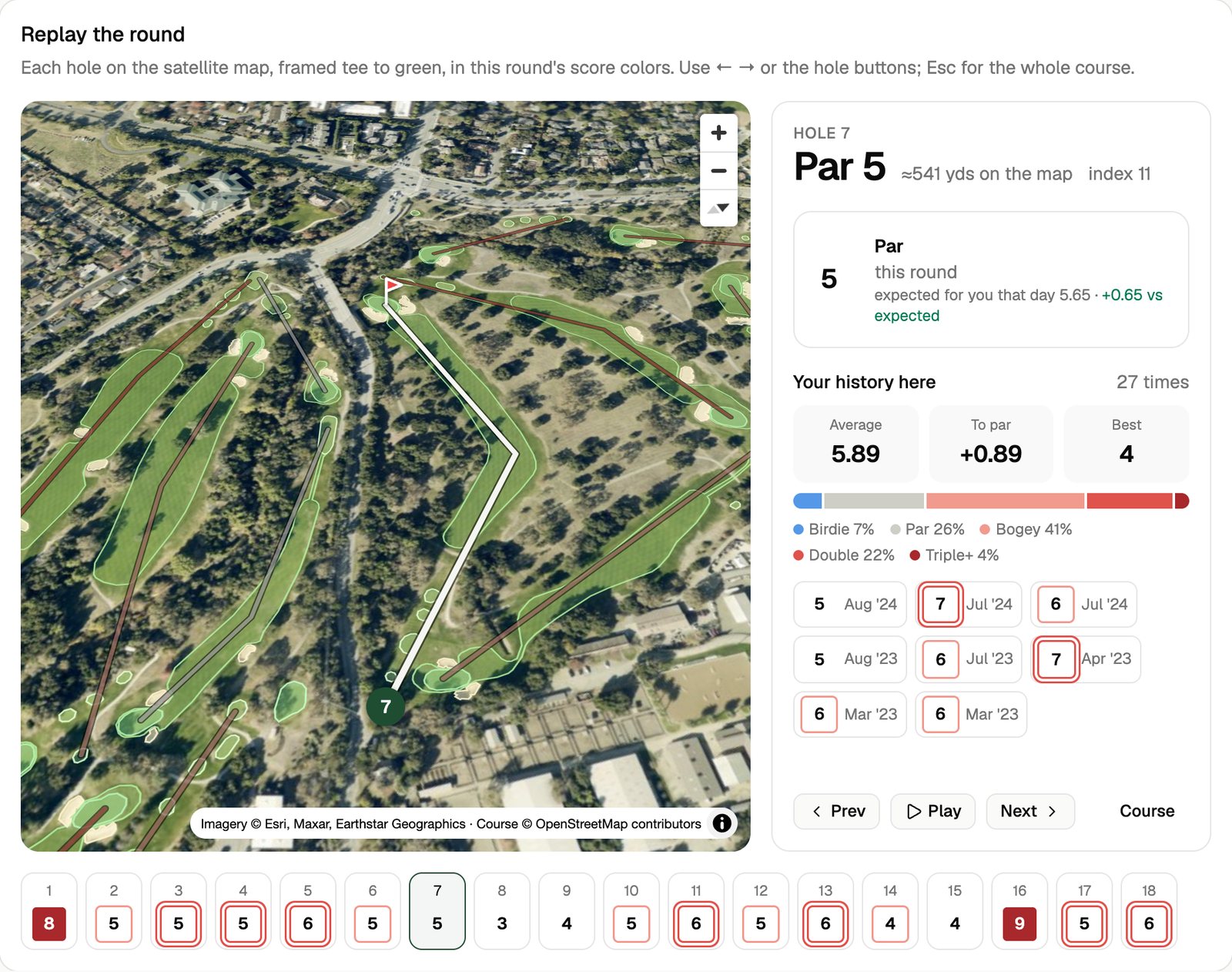
I’m a big fan of Data Golf, so I asked Claude to look through their site and borrow what made sense for an amateur. The result is a page that estimates what I’ll actually shoot next time out (a few strokes worse than my handicap suggests) and forecasts my next round at each of my regular courses.
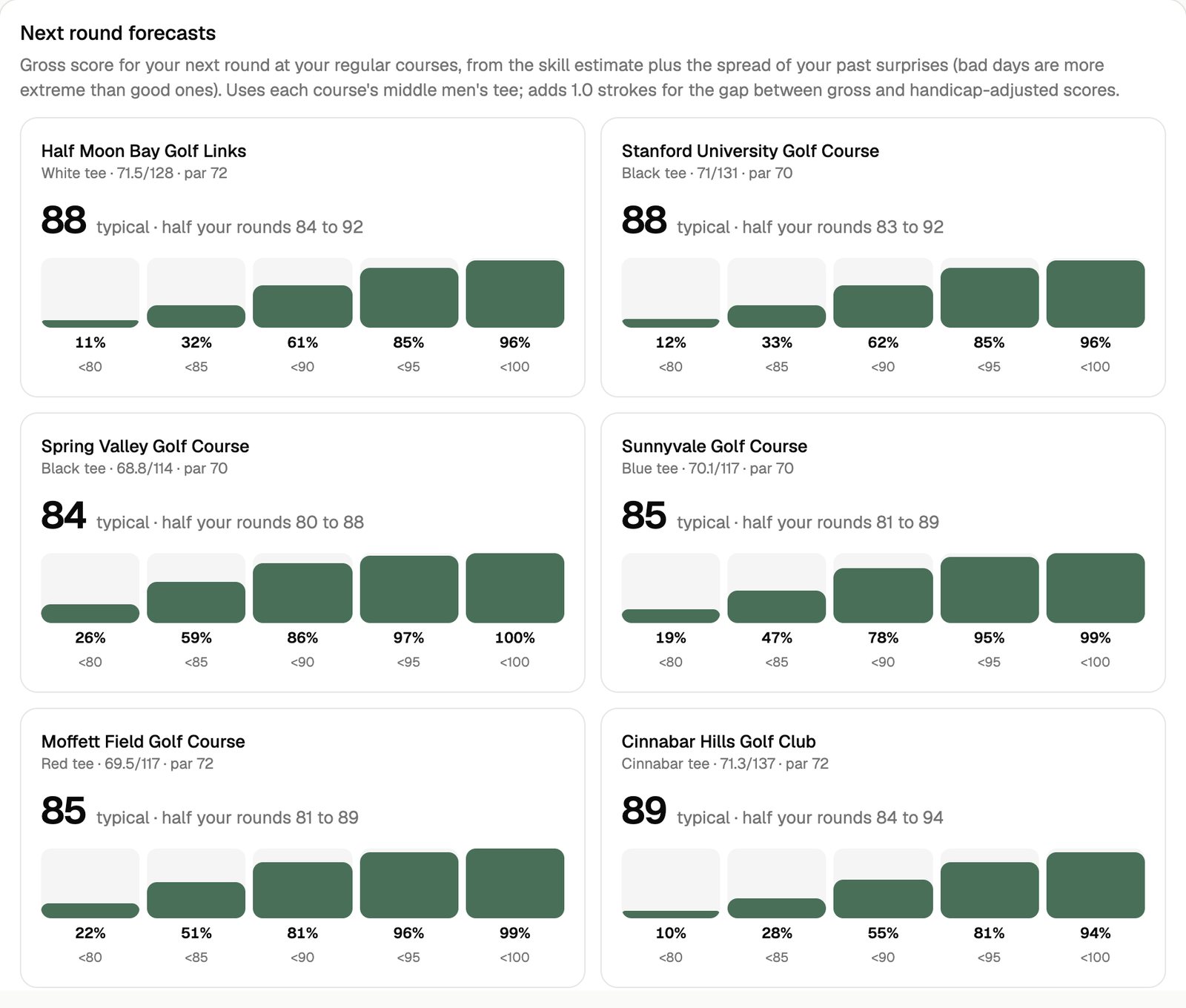
The part I enjoyed most was the maps. Most of the Bay Area courses I play have their holes traced in OpenStreetMap, so every round now has a replay: step through it with the arrow keys and each hole is framed on satellite imagery, with my score, what I’d be expected to make, and every other time I’ve played it.
What my rounds said
My favorite page is the game plan. Every finding comes with the evidence, something concrete to try, and a rough estimate of how many strokes it’s worth.
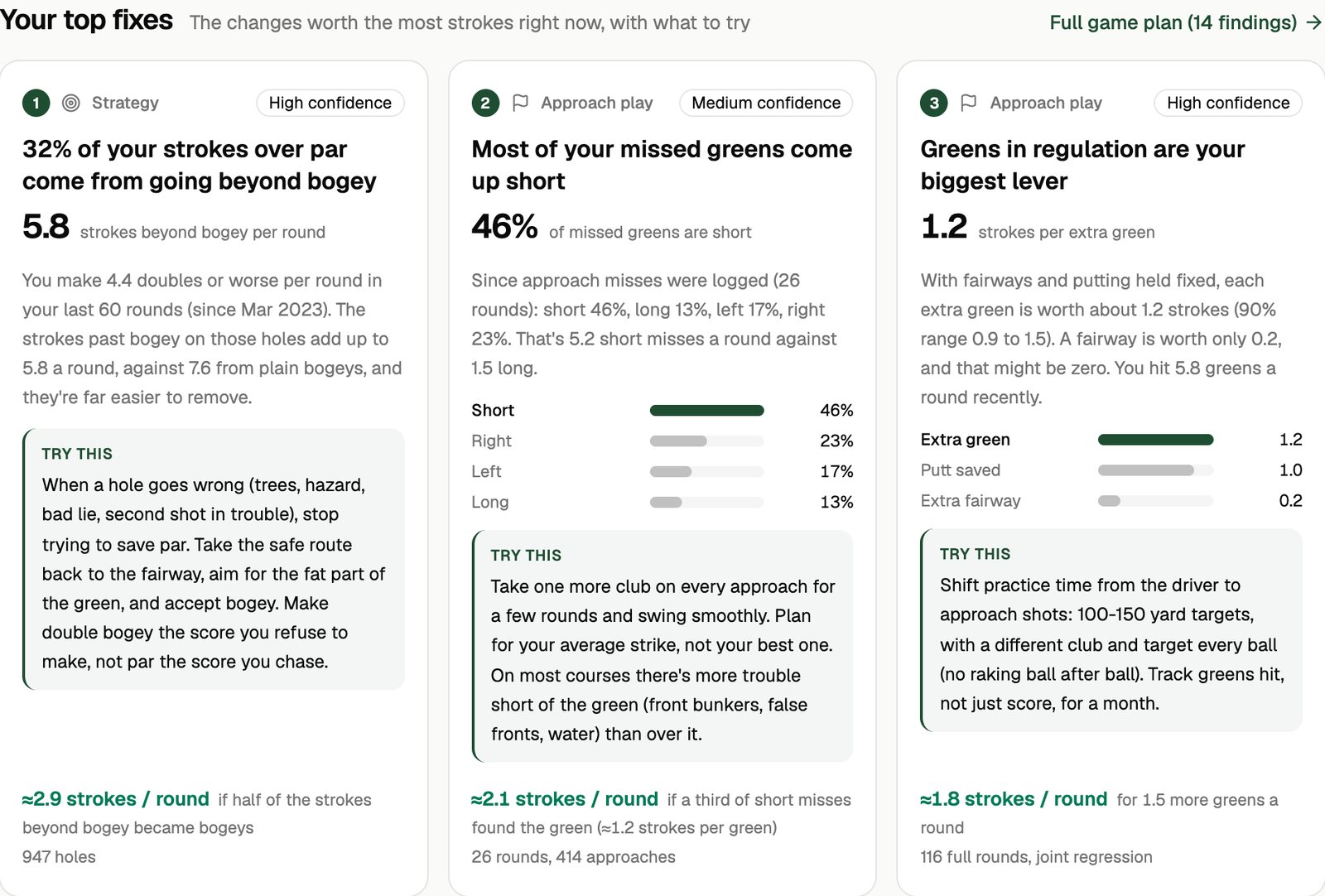
- Stop making doubles. 32% of my strokes over par come from going beyond bogey, almost 6 a round. My bad rounds don’t have more bogeys than my good ones. They have more doubles: 6.9 a round on my worst days against 3.7 otherwise. The fastest way down for me isn’t better shots, it’s fewer disasters.
- Take one more club. 46% of my missed greens come up short, and only 13% long.
- Practice approaches, not driver. For me, hitting more greens is worth far more than hitting more fairways.
I also compared my averages with Shot Scope’s numbers for a typical 10 handicap. Over my last 20 rounds I hit greens about as often as they do (36% against 35%), but fewer fairways (40% against 50%), and par 4s are where I give up the most: about 3 strokes a round.
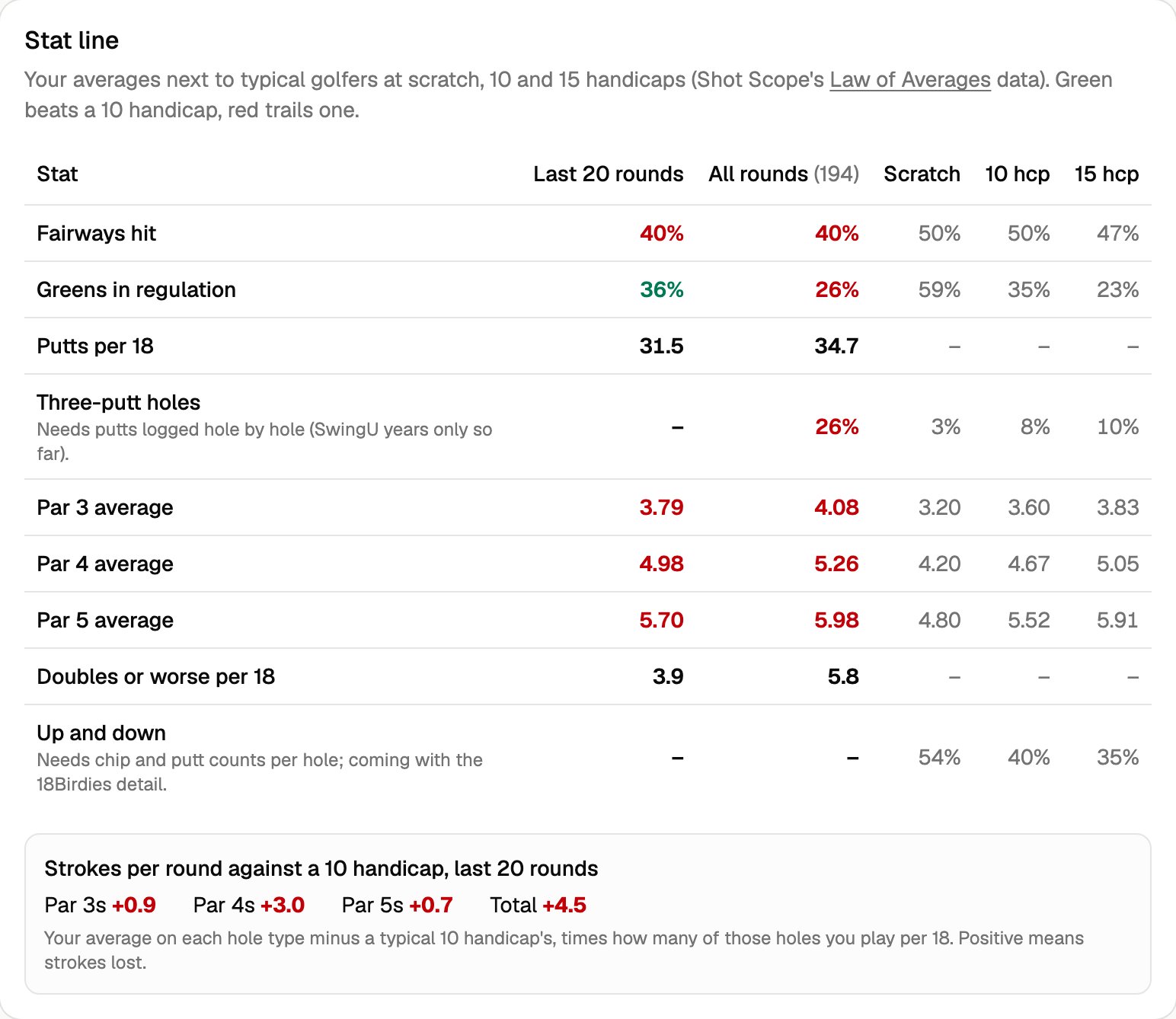
It also found that I play better before 10am, and that hole 16 at Half Moon Bay’s Old Course has my number. None of it is shocking golf advice. But seeing it in my own numbers, ranked by what it’s worth, is a lot more motivating than reading it in a magazine.
What the range said
In August and September 2024 I hit 1,994 balls over 29 sessions at a Toptracer range, and SwingSync pulled every shot out with its carry, height, launch, spin and curve. Range balls fly a little differently from the ones I play on the course, so the exact yardages are probably a bit off, but the patterns are clear.
My typical 7 iron carries 157
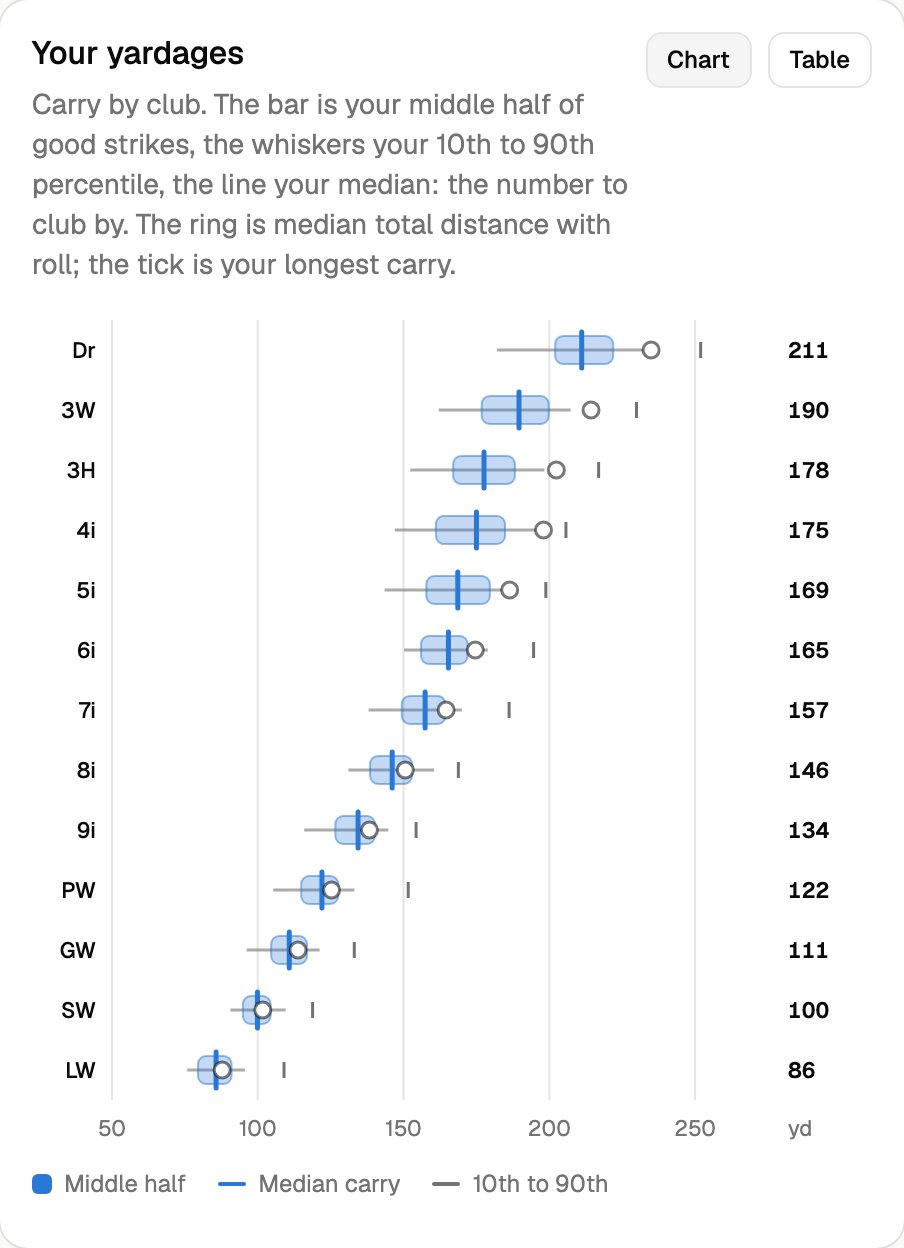
On a good strike, my 7 iron carries 157 yards. Half of them land between 149 and 164, only one in ten goes past 170, and my longest was 186.
Four clubs, one distance
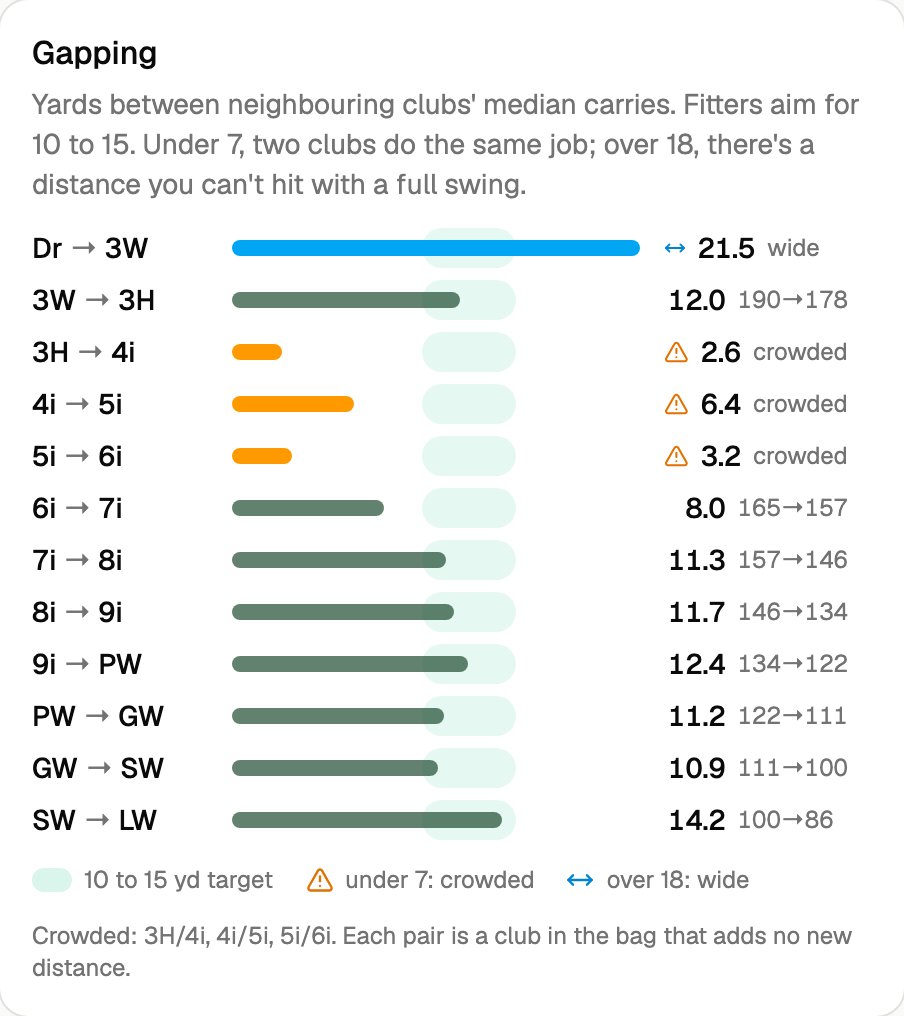
My 3 hybrid, 4 iron, 5 iron and 6 iron carry 178, 175, 169 and 165. Four clubs inside about 12 yards, where you’d want 10 to 15 between each. I’ve been carrying one club with four numbers on it. From the 6 iron down the gaps are textbook, and the wedges are the best part of my bag.
Here’s how high the ball gets, club by club, next to tour averages:
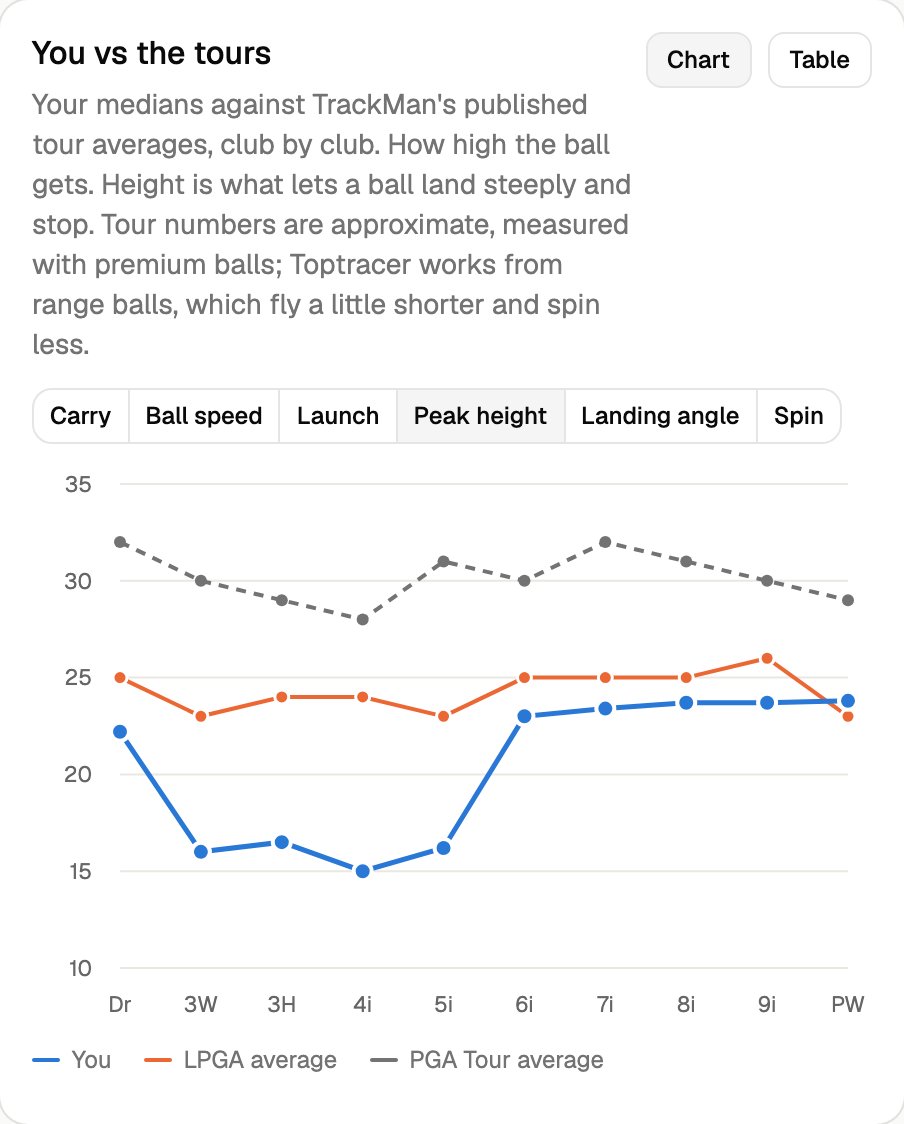
From the 6 iron down, my shots get about as high as an LPGA player’s. Above that they fall off a cliff. My 4 iron peaks at 15 yards; a tour player’s peaks at 28. It also comes down at a much shallower angle: 29° against about 48° for a tour 4 iron.
More ball speed than an LPGA player, less carry
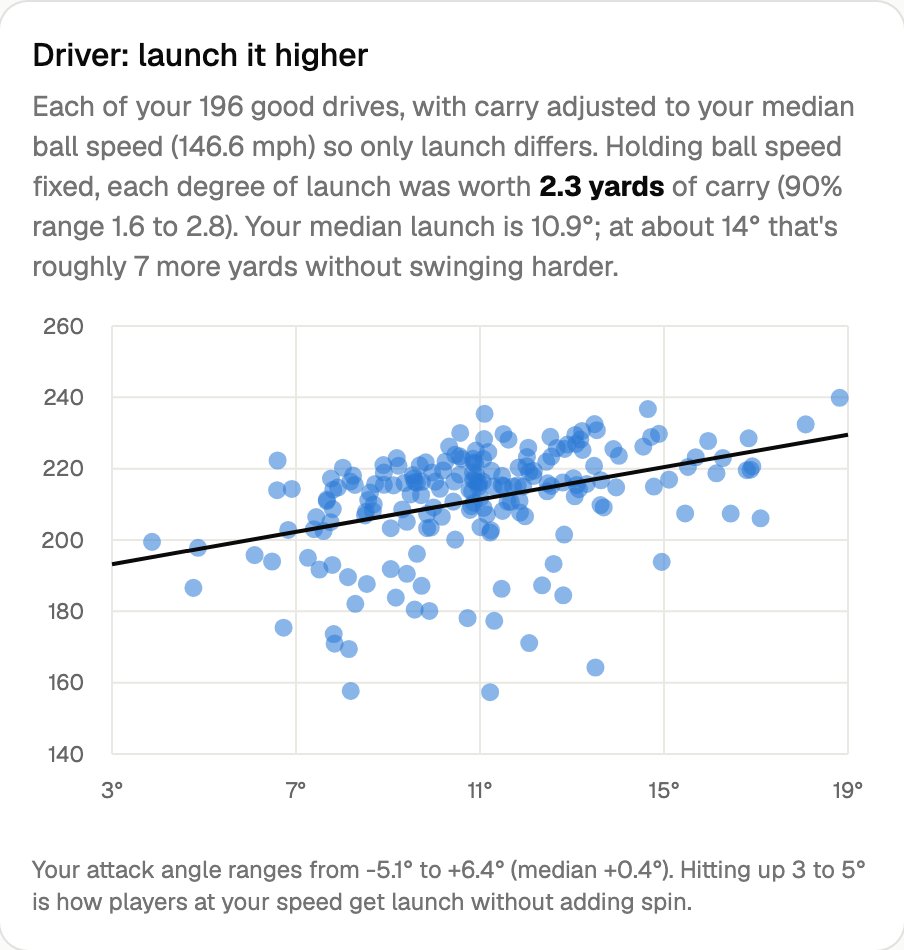
My driver ball speed is higher than the LPGA average (147 mph against 140), but I carry it 211 yards to their 218, because they hit it higher. Launching it like they do would be worth roughly 7 yards without swinging any harder.
The big miss is a hook
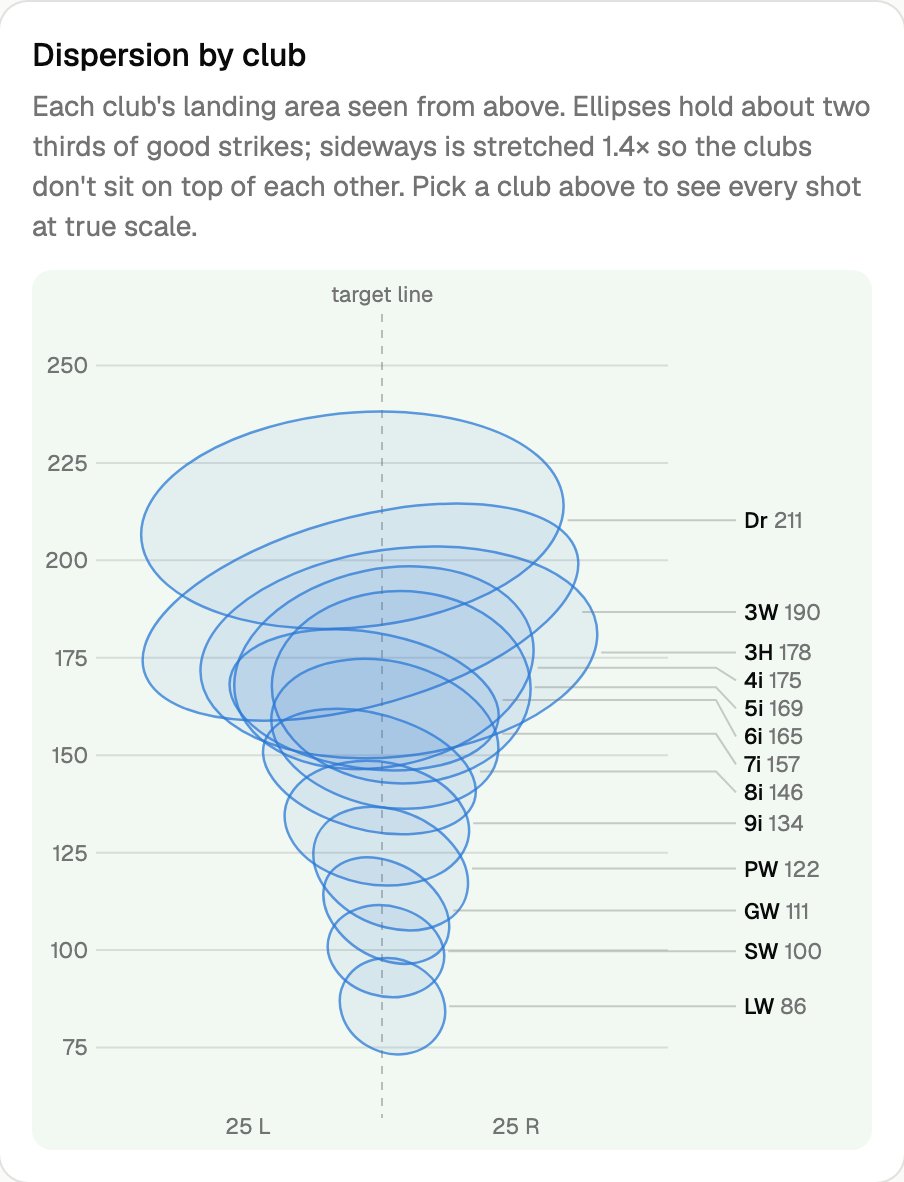
55% of my full swings curve left. With irons that’s mostly a draw. With the driver it’s a hook: 20% of my good drives finish more than 30 yards left, against 9% more than 30 right.
Interestingly, my logged fairway misses on the course split about evenly between left and right.
The first 40 balls are the worst
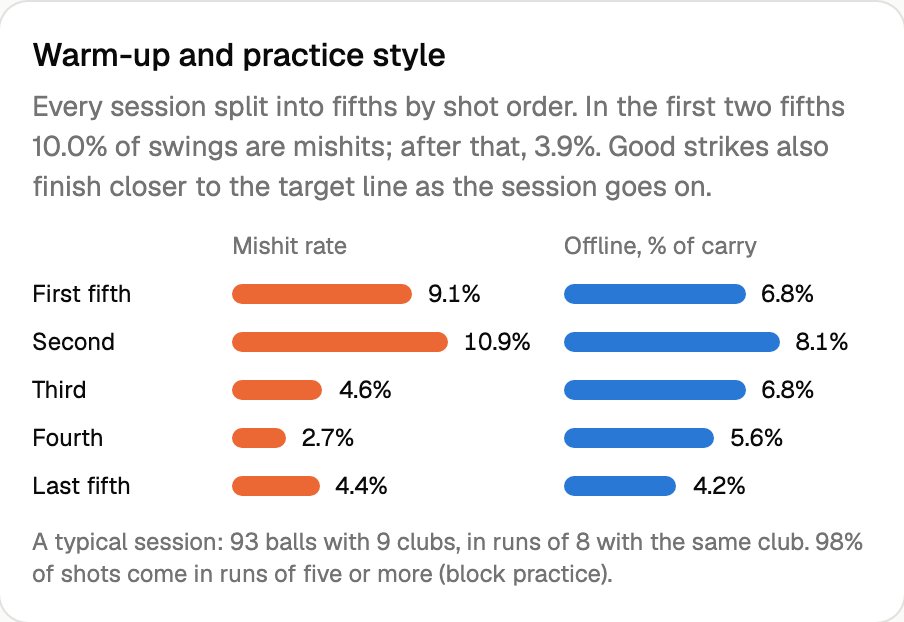
In the first 40% of a session, 10% of my swings are mishits. After that, under 4%. On the course you don’t get 40 balls, so the first tee gets the cold swing.
The data also showed how I practice: about 90 balls a session, hit in runs of 8 with the same club. The standard advice is to switch clubs and targets every ball instead. Yes, I know. Seeing it in my own numbers makes it harder to ignore.
Straighter, but less clean
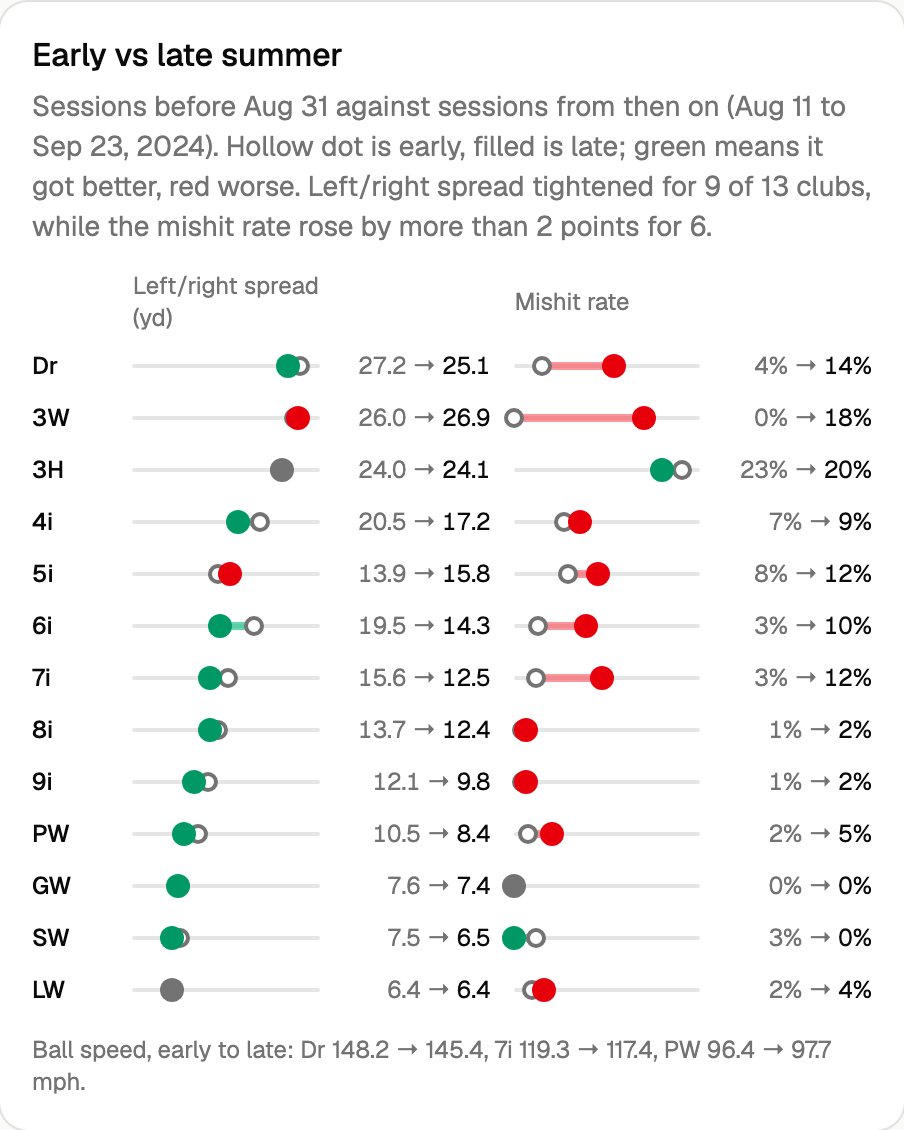
Over the summer I got straighter with most clubs (the 6 iron’s spread went from 19.5 yards to 14.3), but my mishits went up at the same time (the 7 iron from 3% to 12%).
What I’m changing
- Club by my real carries. Put them on a card in the bag, and between clubs, take the longer one.
- Fix the top of the bag. Four clubs for one distance is two too many. Swap some of them for clubs that launch higher, and have a fitter check the gaps.
- Launch the driver higher. Tee it higher, ball forward, sweep up through it.
- Play for bogey on the hardest holes, where most of my doubles happen.
- Warm up before rounds that matter.
- Mix up range sessions. Instead of hitting the same club over and over, switch clubs and targets every few balls, the way a round actually goes.
What’s next
First, the hole-by-hole data that 18Birdies didn’t export: putts, chips, sand shots and penalties on every hole. With that in, some of these findings may change, and the dashboard can finally say something useful about my short game and putting.
After that, I’d like hole maps for Spring Valley, my most-played course, and for my courses in Korea.
Separately, I’ve been working with Claude on editing my old range session footage and connecting it to my Toptracer sessions, so each clip shows where the shot went and how far. Subscribe to my YouTube channel if you want to catch those.
I do know what any golf coach would say. The old rule is to practice your short game twice as much as your long game, and here I am with 1,994 range balls and a whole dashboard about them. But this was about looking at what I actually do, which is hit buckets of balls at the range and walk onto the first tee without warming up. The short game is next. Probably.
If you track your rounds or range sessions and want something like this for yourself, let me know.